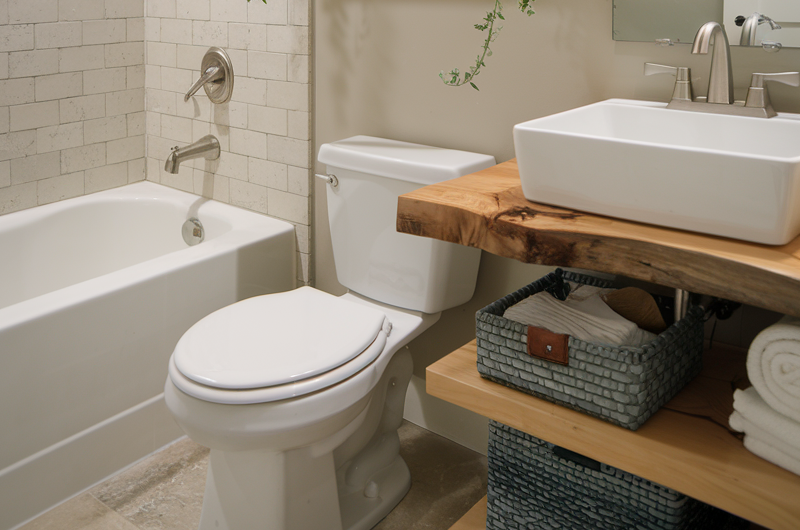
Small bathrooms get a bad rap.
Too tight. Too tricky. Too limiting.
But show me a tiny bathroom, and I’ll show you opportunity.
After working with plenty of compact spaces, I’ve learned this: the smallest bathrooms often benefit the most from smart design. With the right layout tweaks, clever storage, and a little rule-breaking, even the most modest bathroom can feel intentional and inviting.
These 22 small bathroom ideas blend function with personality. Some solve everyday problems. Some add unexpected charm. All of them are realistic—even if your bathroom feels more “cozy” than spacious.
Hang an oversized mirror to double visual space

This is always my first move in a small bathroom. Always.
An oversized mirror tricks the eye like nothing else. It bounces light around, reflects depth, and instantly makes the room feel less boxed in. Even if your bathroom is narrow, a wide mirror can stretch it visually.
I like mirrors that go wall-to-wall above the vanity. Not the tiny builder-grade ones. Go bigger than feels comfortable. That’s where the magic happens.
If you can’t do full width, go tall instead. A mirror that nearly touches the ceiling draws the eye upward and makes the room feel taller than it really is.
Framed or frameless? Depends on your style. Frameless keeps things sleek. A thin metal frame adds character without bulk.
And lighting matters here. Pair the mirror with soft side sconces or a clean overhead fixture. The reflection will amplify everything. Including the good stuff.
Install wall-mounted faucets to reduce visual clutter

This one feels subtle until you see it in action.
Wall-mounted faucets free up counter space and remove visual noise from the vanity top. In a small bathroom, less clutter equals more calm.
I’ve used this trick in bathrooms where the sink barely had room for soap. Suddenly, there’s space. Real, usable space.
It also lets you choose slimmer vanities. Without deck-mounted hardware, you can go shallower and still feel comfortable using the sink.
Installation does require planning. You’ll need access to plumbing inside the wall. But if you’re already renovating, it’s worth considering.
Pair wall-mounted faucets with simple basins. Let the faucet become a design feature without overwhelming the space.
Use large-format tiles to reduce visual breaks

This one surprises people.
Bigger tiles in a small bathroom actually make the room feel larger. Fewer grout lines mean fewer visual interruptions. The space reads as more open.
I like large porcelain tiles on floors and even walls. Neutral tones work best here, but texture can still shine.
If you’re worried about slipping, choose matte or textured finishes. Large doesn’t mean slick.
You can run the same tile from floor to wall for a seamless look. It’s especially effective in shower areas.
Remember this idea when we talk about continuous color later. These ideas build on each other.
Replace swinging doors with pocket or sliding doors

Door swing can steal more space than you realize.
If your bathroom door bangs into the vanity or toilet, it’s time to rethink it. Pocket doors are ideal if construction allows. Sliding barn-style doors work too, with the right aesthetic.
I’ve seen bathrooms gain functional square footage just by changing the door. Suddenly, movement feels easier.
If a full replacement isn’t possible, consider reversing the swing. Sometimes that alone fixes the problem.
Keep hardware minimal. Heavy handles or oversized tracks can overpower a small space.
Add recessed shelving inside shower walls

Storage without bulk. That’s the goal.
Recessed niches inside the shower keep bottles off the floor and edges clean. They’re functional and visually tidy.
I usually recommend one tall niche instead of multiple small ones. It looks cleaner and fits more.
Tile the niche in the same tile as the shower for subtlety. Or contrast it slightly for interest.
Placement matters. Keep it within easy reach but not where water constantly hits.
This idea pairs well with large-format tiles we talked about earlier. Clean lines all around.
Layer lighting to avoid harsh shadows

One overhead light isn’t enough. Ever.
Small bathrooms need layered lighting just as much as large ones. Maybe more.
Start with ambient lighting. Then add task lighting around the mirror. Sconces at eye level are my favorite.
If you have a shower or tub, consider a wet-rated recessed light inside it. It makes the space feel intentional.
Warm light tones feel flattering and cozy. Avoid harsh blue light. No one wants that at 6 a.m.
Lighting can make or break a small bathroom. Treat it like a design element, not an afterthought.
Keep accessories minimal and intentional

This is where restraint matters.
Too many accessories make a small bathroom feel chaotic. Choose fewer pieces, but make them count.
One soap dispenser you love. One tray. One plant. That’s often enough.
Match finishes where possible. Mixed metals can work, but be deliberate.
Negative space is your friend. Let surfaces breathe.
We’ll revisit this mindset again when we talk about bold choices later.
Extend tile from floor to ceiling for continuity

This is one of my favorite visual tricks.
Running tile from floor to ceiling creates uninterrupted lines. The eye moves upward naturally, making the bathroom feel taller.
I often use this behind the vanity or inside the shower. Even one full-height tiled wall can change everything.
Stick with simple patterns. Busy designs can overwhelm in small doses. Think vertical subway tile or subtle stone looks.
Grout color matters. Matching grout blends lines together. Contrast highlights them. Choose based on the effect you want.
Remember the large-format tile idea earlier? Floor-to-ceiling tile works even better when grout lines are minimized.
Choose a compact toilet designed for small spaces

Not all toilets are created equal.
Compact toilets have shorter projections and slimmer tanks. That extra few inches matters more than you’d think.
Wall-hung toilets are another option. They free up floor space and look sleek. Installation is more involved, but the payoff is big.
If replacing isn’t possible, consider visual tricks. Paint the wall behind the toilet lighter. Keep accessories minimal.
A streamlined toilet keeps the room from feeling crowded. It’s not glamorous, but it’s smart.
Use continuous color to blur boundaries

This idea builds directly on the tile continuity we discussed earlier.
Using the same color on walls, trim, and even ceilings blurs boundaries. The room feels larger because edges disappear.
Soft neutrals work best. But I’ve also done this with moody colors for dramatic effect.
If you’re nervous, start with similar tones rather than exact matches. Close enough still works.
Gloss level matters too. A satin wall with semi-gloss trim adds subtle depth without breaking flow.
This is one of those ideas that feels simple but works quietly in the background.
Incorporate glass shower enclosures instead of curtains

Shower curtains cut visual space in half.
Glass enclosures keep sightlines open. The bathroom reads as one continuous space.
Frameless glass is ideal. Minimal hardware keeps things light.
If privacy is a concern, use frosted or fluted glass. Still airy, but softer.
Keep glass clean. In small bathrooms, grime shows quickly.
Pair this with good lighting, and the shower becomes part of the room—not a hidden corner.
Add built-in storage wherever possible

Built-ins feel custom. And custom feels intentional.
Recessed cabinets, built-in benches, and vanity drawers maximize space without adding bulk.
I love recessed medicine cabinets with mirrored fronts. Storage plus reflection. Two wins.
Look for opportunities between studs. Even narrow cavities can become storage.
This idea works beautifully with the minimalist accessory approach we talked about earlier.
Install a slim console sink for visual lightness

Console sinks feel airy.
They offer the function of a vanity without the visual weight. Perfect for powder rooms or guest baths.
Choose ones with slim legs and integrated towel bars.
Pair with wall-mounted faucets if possible. Even lighter.
Storage is limited, so balance it with vertical shelving or built-ins we discussed earlier.
This idea isn’t for everyone, but when it works, it really works.
Use mirrors creatively beyond the vanity

Mirrors don’t have to live only above sinks.
Mirrored cabinet doors. Full-height mirrors on narrow walls. Even mirrored backsplashes.
They reflect light and add depth in unexpected places.
Just don’t overdo it. One or two strategic placements are enough.
Think of mirrors as architectural elements, not just functional ones.
Choose fixtures with slim, refined profiles

Bulky fixtures eat visual space.
Look for slim towel bars, thin faucet spouts, and streamlined light fixtures.
This doesn’t mean boring. It means intentional.
Matching finishes help unify the room. Brushed nickel, matte black, warm brass—choose one and stick to it.
Remember the minimal accessory rule. Fixtures are part of that story.
Bring in greenery for softness and life

Plants soften hard surfaces.
Even one small plant can make a bathroom feel fresh and welcoming.
Choose humidity-loving plants like pothos or ferns.
Wall-mounted planters save counter space. Or place one on a shelf.
Greenery pairs beautifully with neutral palettes we discussed earlier.
Use textured materials to add depth without bulk

Texture adds interest without stealing space.
Think ribbed tiles, fluted wood, or subtle stone textures.
In small bathrooms, texture replaces excess décor.
Use it sparingly. One or two textures max.
Pair textured elements with smooth surfaces for balance.
This works beautifully with continuous color schemes we discussed earlier.
Install lighting under vanities or cabinets for glow

This is one of my favorite finishing touches.
Under-cabinet lighting adds a soft glow. It lifts the room visually and feels luxurious.
It’s also practical as night lighting.
Warm LED strips work best. Hidden from view.
This idea pairs perfectly with floating vanities from earlier.
Once you try it, you won’t go back.
Rethink towel storage with hooks and ladders

Traditional towel bars aren’t always ideal.
Hooks use less space and hold more.
Wall-mounted ladders lean vertically and feel light.
This idea ties back to vertical storage we discussed early on.
Functional doesn’t have to be boring.
Use reflective finishes strategically, not everywhere

Glossy tiles, polished stone, mirrored accents.
Reflection opens space. But too much feels chaotic.
Pick one reflective element and let it shine.
Balance with matte finishes elsewhere.
This keeps the bathroom interesting without overwhelming it.
Opt for custom solutions when standard ones fail

Small bathrooms rarely fit standard solutions.
Custom shelves, vanities, or storage can maximize awkward corners.
Even semi-custom options make a difference.
Think creatively. That dead space might not be dead after all.
Custom doesn’t always mean expensive. It means thoughtful.
Let natural light lead your layout decisions

If you have a window, protect it.
Don’t block it with bulky elements.
Sheer treatments preserve privacy without sacrificing light.
Natural light amplifies every other idea on this list.
Work with it, not against it.
Final Thoughts
Small bathrooms aren’t limitations.
They’re opportunities to design smarter.
You don’t need all 23 small bathroom ideas. Just one or two done well can transform your space.
Pick an idea that speaks to you. Try it. Build from there.
Your tiny bathroom has more potential than you think.
