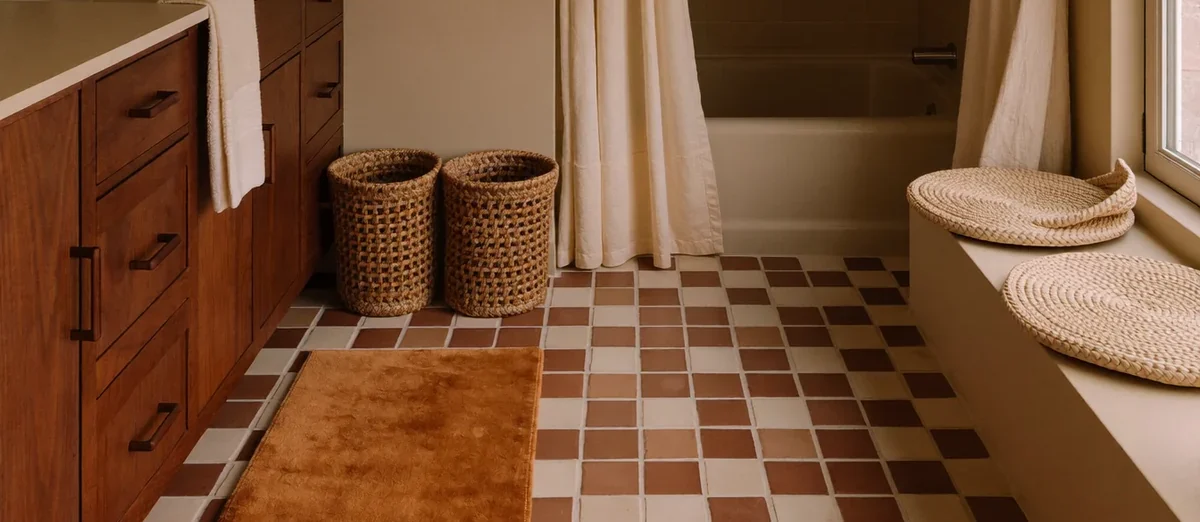
Here’s something I wish someone had told me before my first bathroom remodel: the tile is the decor. Not the towels. Not the little tray by the sink. The tile. It covers more surface than anything else in the room, you see it every single morning, and it’s the one thing you can’t swap on a whim.
So it’s worth getting right. The good news? Great bathroom tile design ideas aren’t about spending the most. They’re about choosing a pattern, a material and a grout color that work together, then letting them do the heavy lifting.
Below are 26 ideas I keep coming back to, from classic herringbone to handmade zellige, tiled ceilings and borders that act like a rug. Grab a coffee. Let’s find the one that feels like yours. ☕
Stack Long Subway Tiles Vertically in the Shower
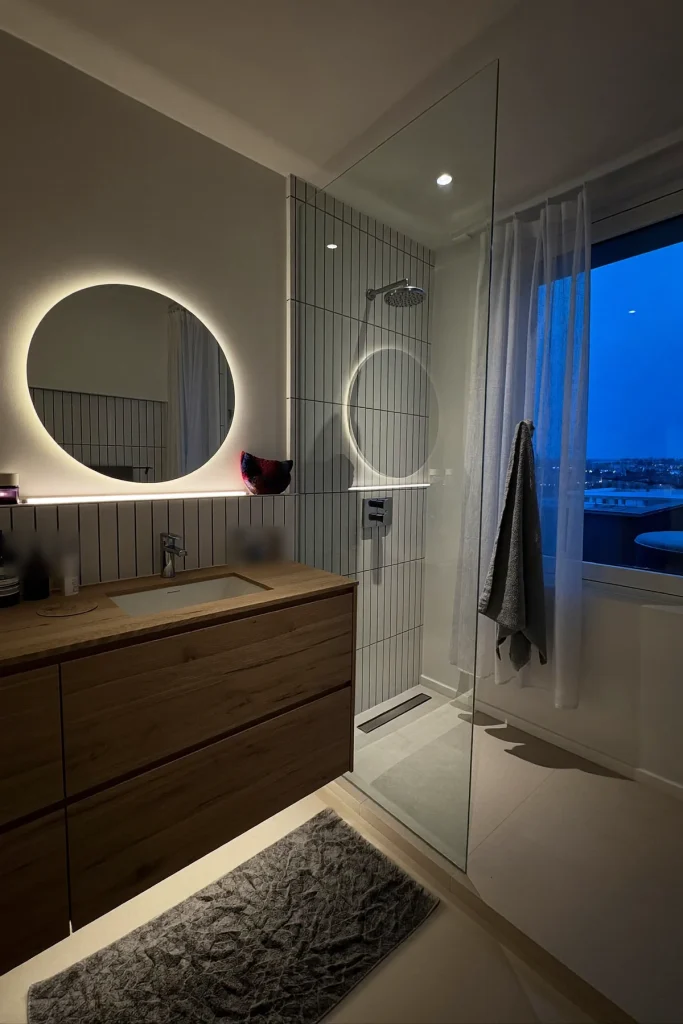
Classic subway tile is lovely. Turn it on its end and stack it straight, and suddenly it feels fresh and a little Scandinavian. 🌿
Vertical stacking draws the eye up, which makes a standard eight-foot ceiling feel taller. Go for a longer, skinny format, something like 2×8 or 3×12 inches, in a soft white or pale oat glaze.
Keep the grout lines tight and the grout color close to the tile so the pattern reads as calm lines rather than a busy grid. A wood bath stool and a linen towel are all the styling it needs.
Wrap the Shower in Glossy Green Zellige
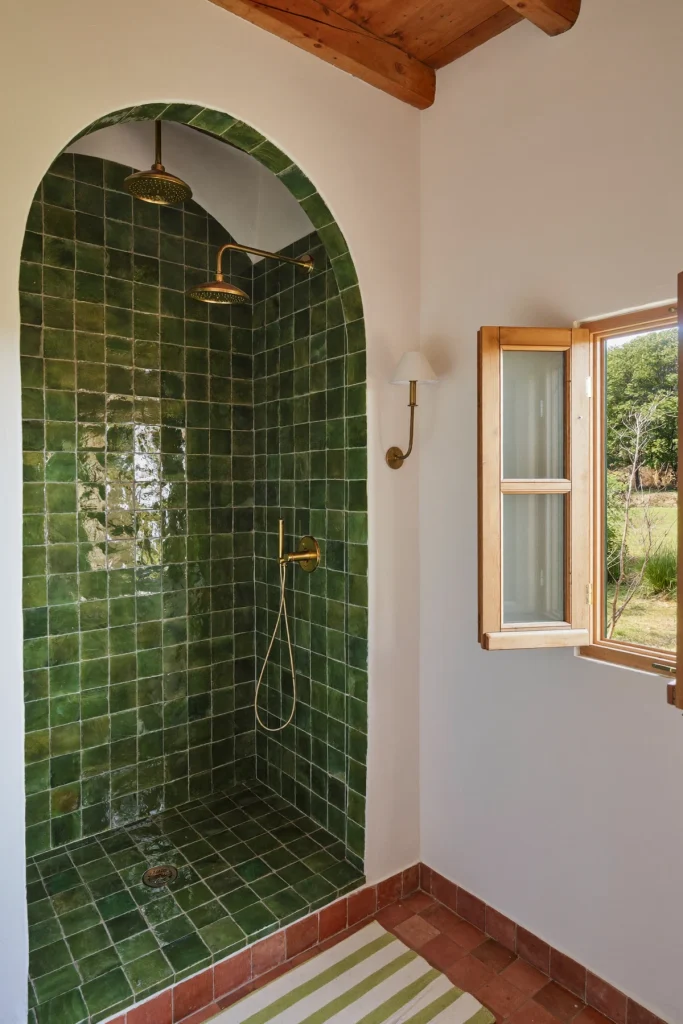
Zellige is the handmade Moroccan tile that looks like it’s been glowing for a hundred years. Every piece is slightly different, a little wavy, with glaze that pools and catches the light.
A deep olive or sage green in a shower feels earthy and rich, especially next to warm plaster walls and brass fixtures. It’s at its best in a Mediterranean-inspired bathroom with plenty of sunlight bouncing around.
Don’t fight the irregularity. That’s the whole point. The chips and color shifts are what make it feel alive.
Pro Tip
Order 15–20% extra. Zellige has more breakage and more culls than machine-made tile, and you’ll want spare pieces for repairs years from now.
Go Bold With an Encaustic Cement Floor
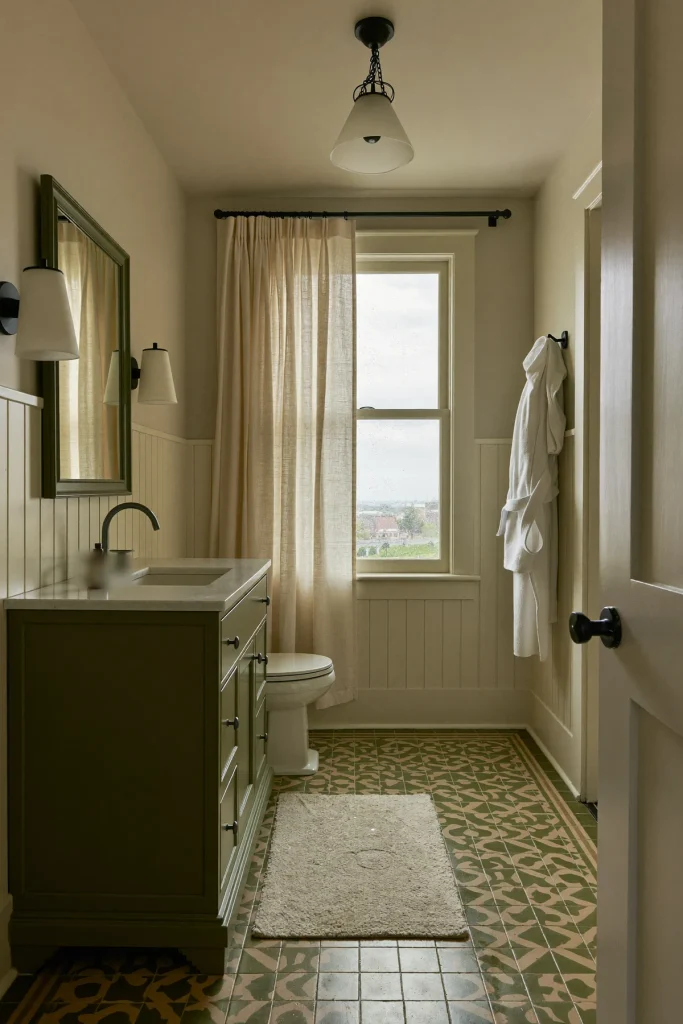
Patterned cement tile is how you get personality into a bathroom without a single piece of art. Think starbursts, florals, or geometric medallions in two or three colors.
Because the pattern is so strong, keep the walls quiet: white painted beadboard or a simple plaster finish works beautifully. In a Craftsman bungalow, a moss green and cream pattern feels like it’s always been there.
Cement tile is porous, so it needs sealing before grouting and again every year or two. A little upkeep, a lot of charm.
Common Mistakes to Avoid
- Skipping the sealer before grouting (dark grout can stain the tile permanently).
- Using a busy pattern on the walls too.
- Cleaning with acidic or bleach-based products.
Pave the Floor in a Classic Black-and-White Checkerboard
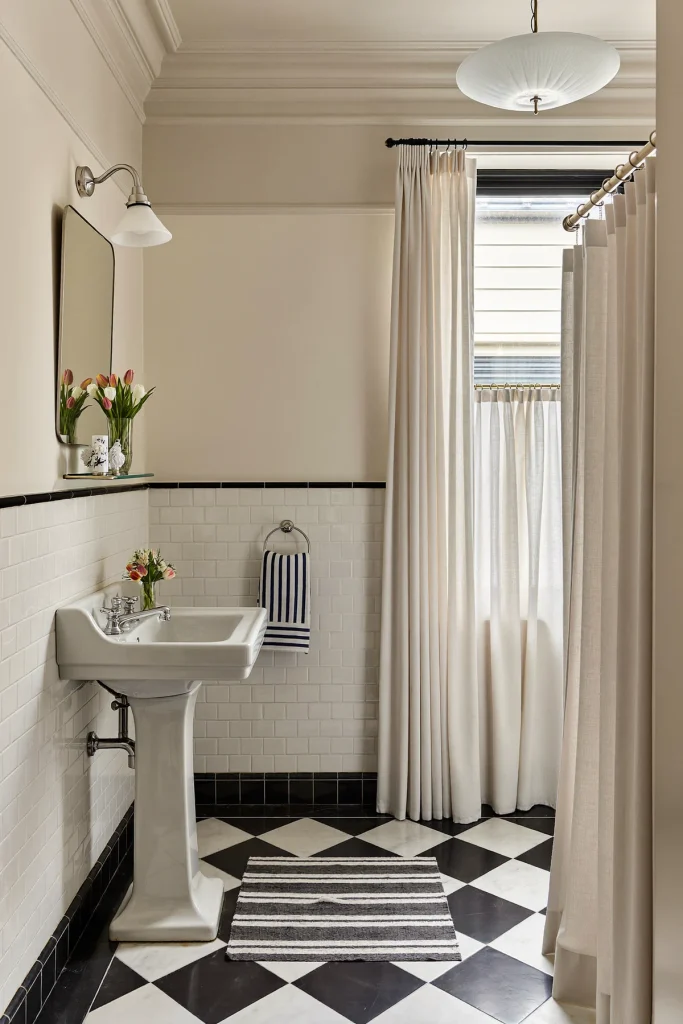
Few bathroom floors have stayed in style as long as the checkerboard. It works in a prewar apartment, a Victorian, a cottage, even a sleek modern bath.
For an old-house feel, use smaller squares, around 4 or 6 inches, in a honed finish. For something softer, try a cream and warm taupe check instead of stark black and white.
Set it straight or on the diagonal. Diagonal is a touch more playful and helps hide walls that aren’t perfectly square, which, in older homes, is most of them. 😉
Style Match Guide
| Checkerboard Colors | Best For |
|---|---|
| Black and white | Prewar, Art Deco, classic |
| Cream and taupe | Cottage, farmhouse |
| Sage and ivory | Scandinavian, English |
| Terracotta and cream | Mediterranean-inspired, Spanish |
Tile to Wainscot Height and Finish With a Pencil Trim
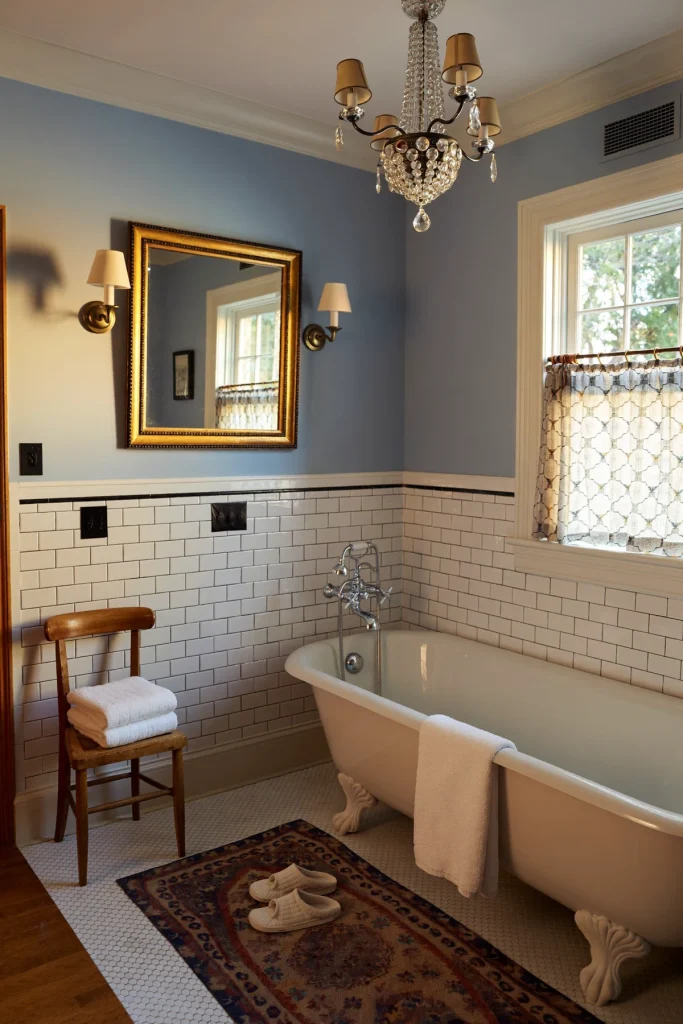
You don’t have to tile every wall to the ceiling. Running tile to about 42 to 48 inches and topping it with a slim pencil trim or chair rail tile gives you that classic old-house look and saves real money.
Paint or wallpaper above the line in a color that picks up the tile. Soft blue over white subway tile is a forever pairing in a Victorian bathroom.
This height also protects the walls where splashes actually happen, around the sink and toilet, while leaving the top half free for color you can change later.
Frame the Vanity With a Fish Scale Backsplash
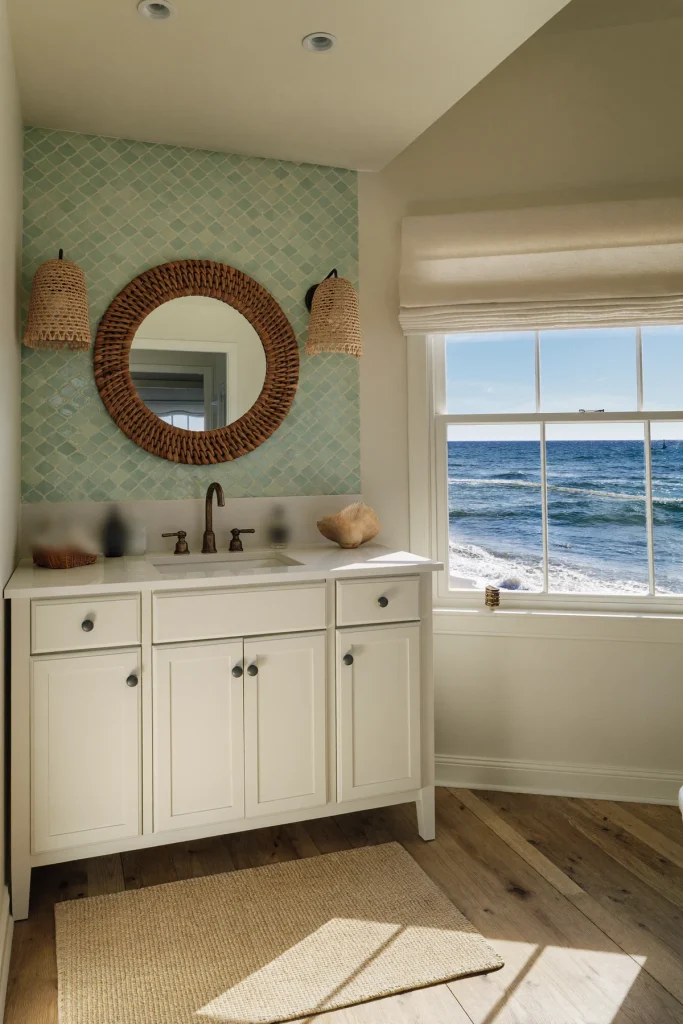
Fish scale tile, sometimes called scallop or mermaid tile, is soft, curvy and quietly romantic. 🐚
Use it as a backsplash behind the vanity rather than across a whole wall. A pale aqua or seafoam glaze looks lovely in a coastal-inspired bathroom, while a soft white keeps things classic.
The curves soften all the hard lines in a bathroom: mirror, counter, faucet. Keep the mirror simple, maybe a round one in rattan or white wood, so the shapes echo each other without competing.
Choose Terrazzo for a Floor That Hides Everything
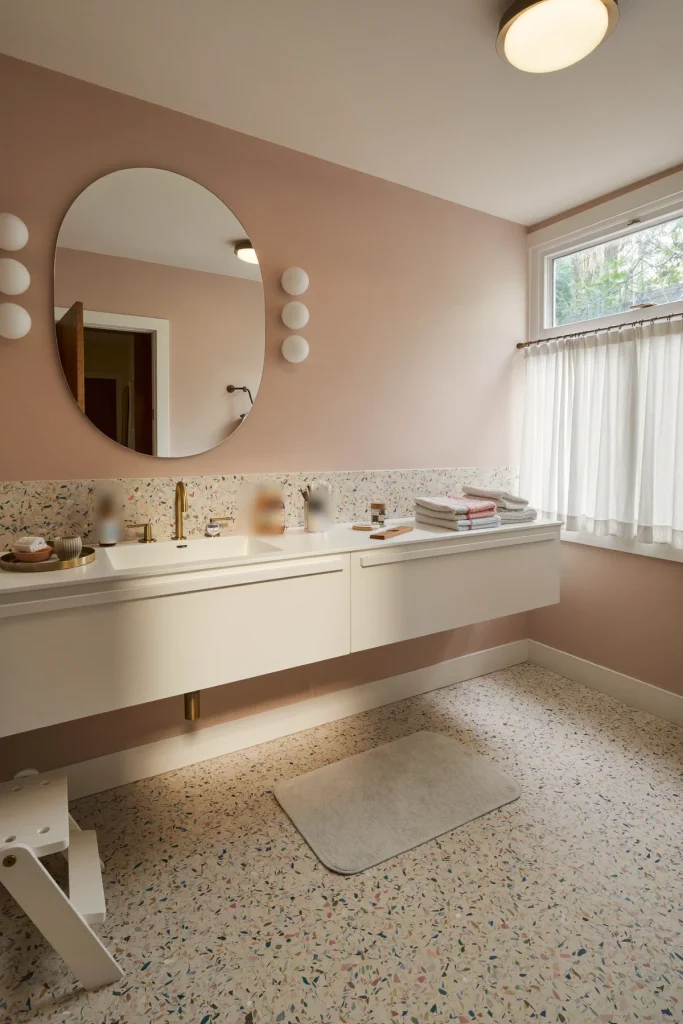
Terrazzo tiles are speckled with chips of stone or glass, and that confetti effect is the secret weapon of every busy family bathroom.
Water spots, dust, a stray hair tie on the floor? Barely visible. A white base with soft pink, grey and green chips feels cheerful in a kids’ bathroom without being childish.
Porcelain terrazzo-look tile gives you the same pattern with less maintenance than real terrazzo. Keep the walls simple with a single color so the floor stays the playful bit.
Who This Is For
Parents of young kids, anyone sharing a bathroom with teenagers, and anybody who’d rather not mop every day.
Tile the Ceiling for a Cocoon Shower
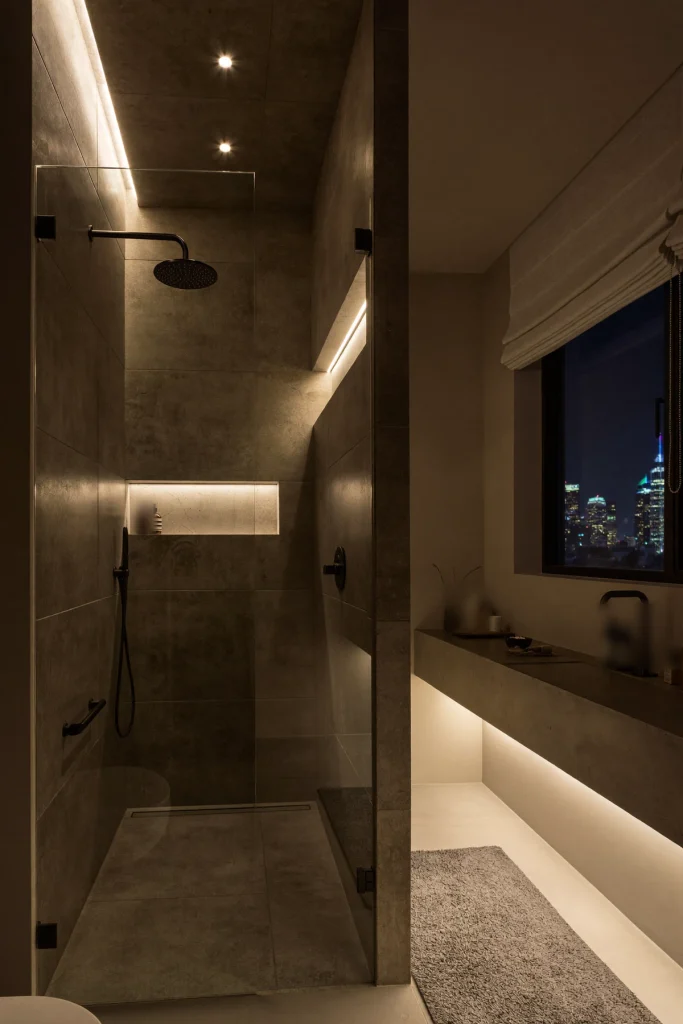
Here’s an idea most people never consider: keep going. Tile the walls, then carry the same tile right across the shower ceiling.
The effect is wrapped and cocooning, like standing inside a polished stone box. Large-format concrete-look porcelain works beautifully here for a brutalist, loft-style bathroom, because fewer grout lines overhead means a cleaner look.
It’s also practical. Ceilings above a steamy shower are where paint peels and mildew starts. Tile simply doesn’t care about steam.
Ask your installer about a slight slope or a well-placed vent so condensation doesn’t drip on you. Add a recessed, wet-rated light and you’ve got a shower that feels like its own little room.
Lay Hexagon Tiles That Flow From the Floor Up the Wall
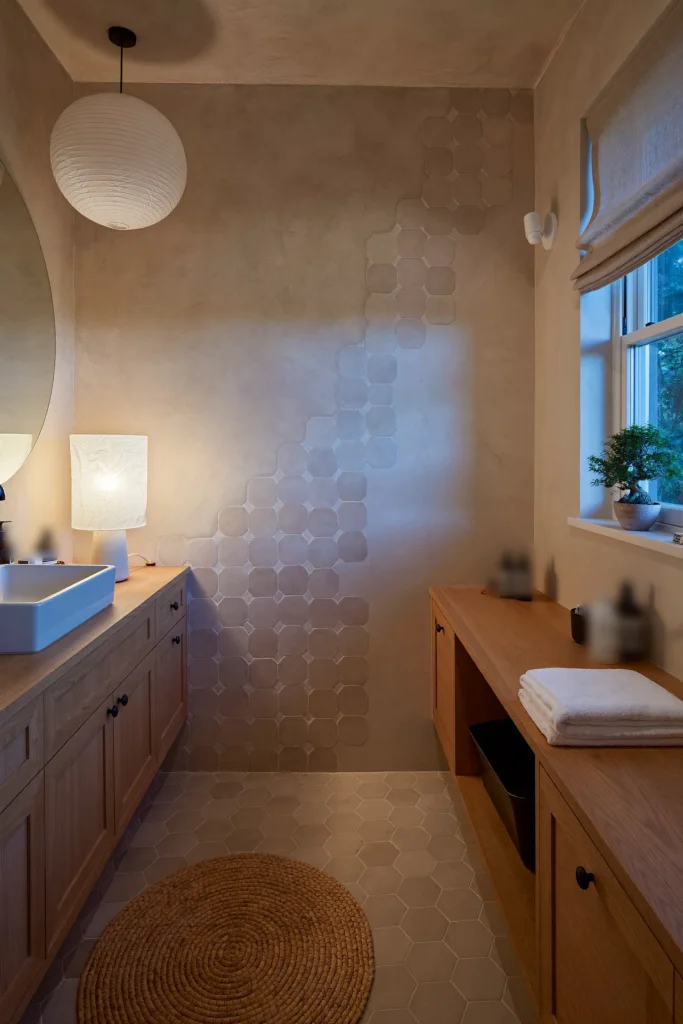
Hexagons are already lovely on a floor. But let them climb a few feet up the wall in an organic, scattered edge, and they become a conversation piece.
This works best with a single color hexagon in matte white or soft sand, fading into plain plaster or a painted wall. In a Japandi-inspired bathroom, it feels calm and natural, like the tile is growing up from the ground.
Plan the edge carefully before anyone picks up a trowel. Lay the tiles out on the floor first, take a photo, and adjust until the shape feels loose and uneven rather than stepped.
It’s more labor, so expect your installer to charge a little extra for the cuts and the planning. Worth it.
The Squint Test
Before committing to any pattern, tape a few samples to the wall, step back to the doorway and squint. If the pattern still reads clearly, it’ll look intentional. If it turns to mush, go bigger or simpler.
Try a Basketweave Marble Floor
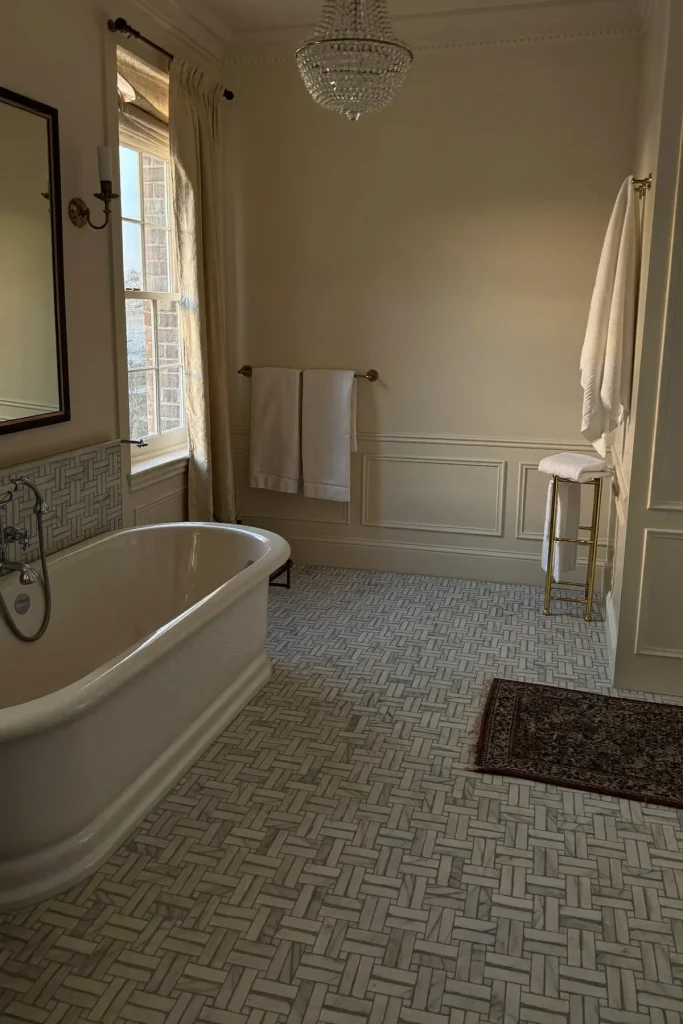
Basketweave is the floor you find in grand old houses and the bathrooms of people who clearly know what they’re doing. Pairs of small rectangles alternate direction, usually with a tiny contrasting dot where the corners meet.
White Carrara with little grey or black dots feels classic and crisp. For something warmer, try cream marble with a soft taupe accent.
Because the pattern is small and tight, it adds texture without loudness. It’s a natural fit for a traditional primary bathroom with a clawfoot or soaking tub and painted panelled walls.
Most basketweave comes on mesh sheets, so installation is easier than it looks. Just make sure the sheets line up so the weave doesn’t drift across the room.
Warm It Up With Handmade Terracotta Floors
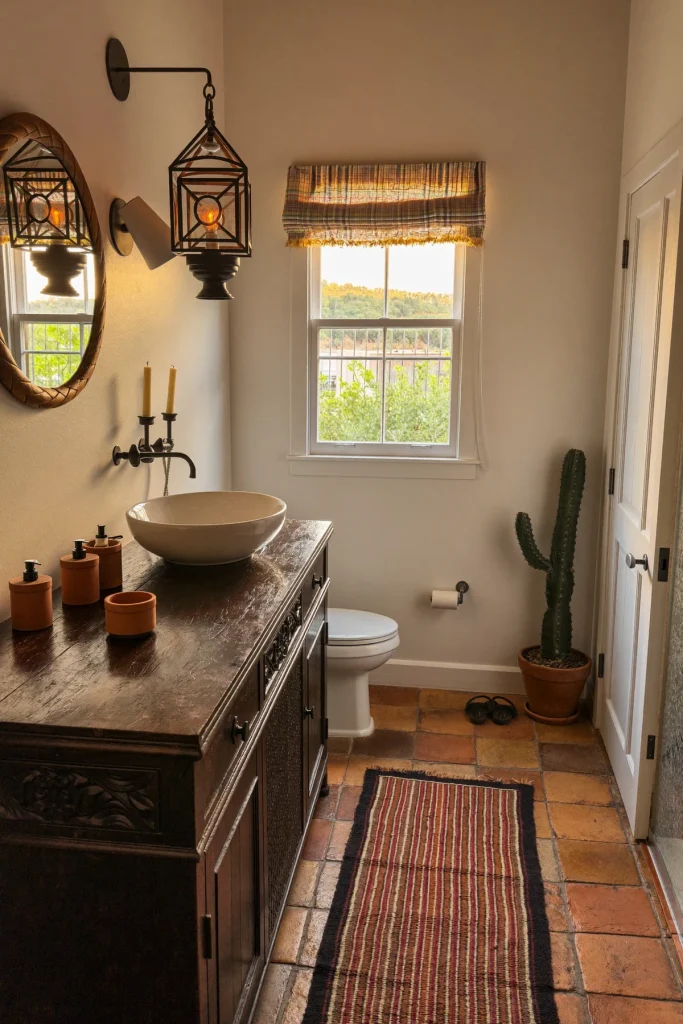
If your bathroom feels cold, literally or visually, terracotta is the fix. Those earthy orange, rust and honey tones instantly make a space feel warm and sunbaked. 🧡
Handmade terracotta pavers have soft edges and color variation that age beautifully. They’re perfect for a ranch house or a Spanish-style bathroom with white plaster walls and dark wood.
Seal them well, because unglazed terracotta drinks up water. Over time, they develop a soft patina that only looks better.
Want the look with less upkeep? Glazed terracotta or a terracotta-look porcelain gives you the warmth without the sealing schedule.
Myth-Buster
“Terracotta is too rustic for a modern bathroom.” Not true. Paired with a sleek floating vanity and matte black fixtures, it reads warm and modern, not farmhouse.
Line the Tub Surround in Large Porcelain Slabs
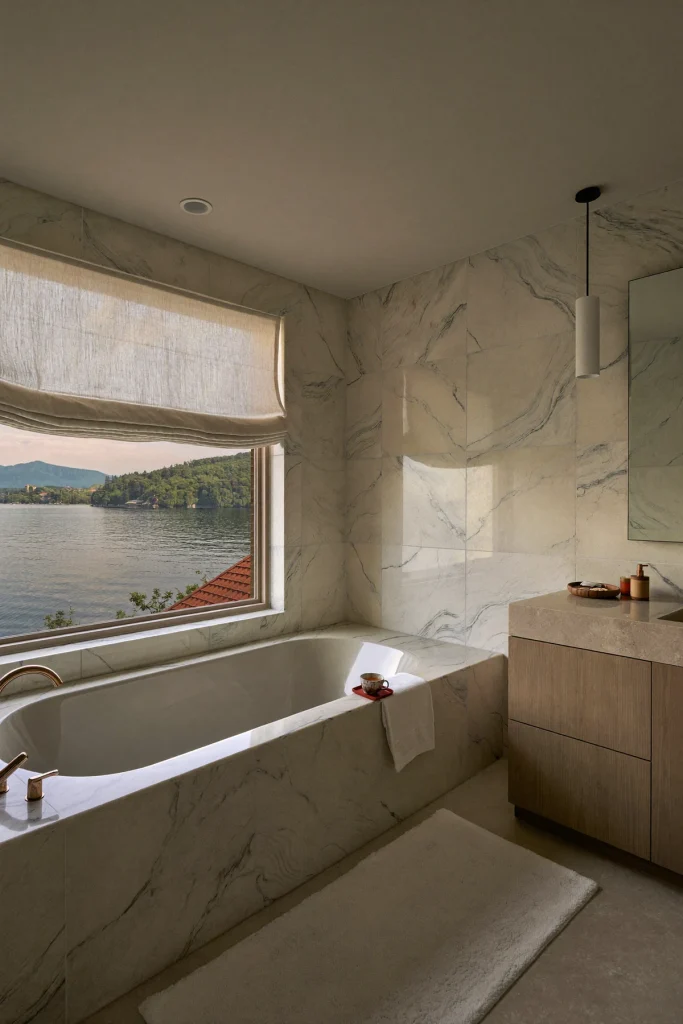
Large porcelain slabs, sometimes as big as 5 by 10 feet, give you the look of a single sheet of stone with almost no grout lines.
Around a tub, they feel incredibly clean and calm. Choose a soft marble-look slab with gentle veining for a serene lake house bathroom, or a warm limestone look for something earthier.
Fewer grout lines also means less scrubbing, which is a gift you’ll appreciate every single weekend. 🛁
These slabs are heavy and tricky to install, so this is one job for a specialist rather than a weekend DIY. Ask whether they can bookmatch the veining for a mirror-image effect.
Cost Breakdown
| Option | Rough Cost Range |
|---|---|
| Large porcelain slab (installed) | Around 30–60 per sq ft |
| Natural marble slab (installed) | Around 60–150+ per sq ft |
| Large-format 24×48 tile | Around 15–35 per sq ft |
Use Wood-Look Porcelain for a Cabin Feel
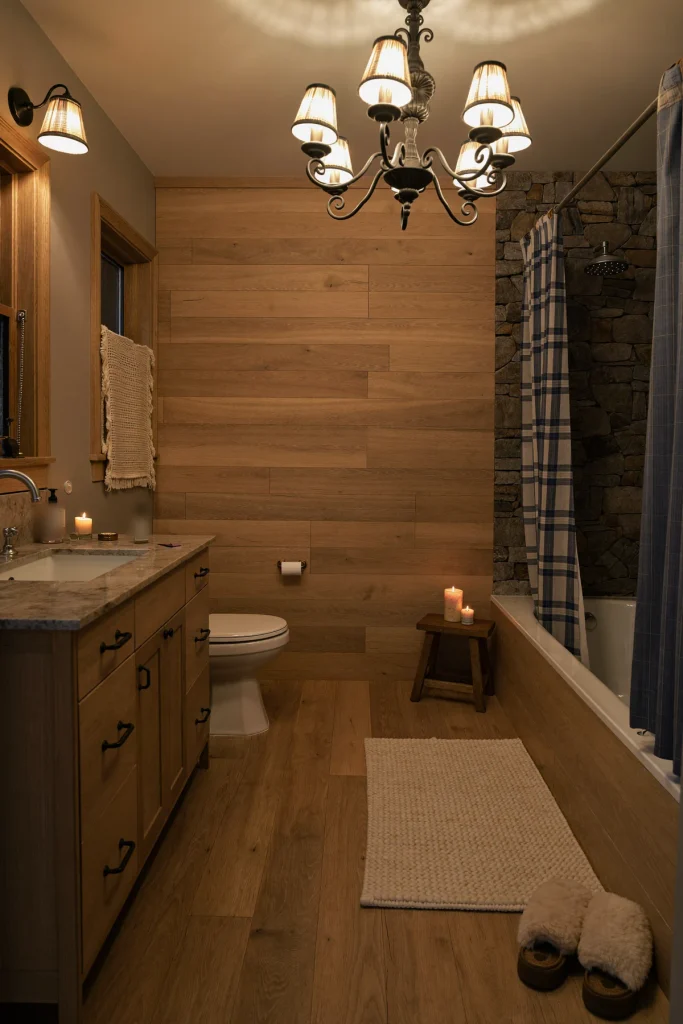
Love the warmth of wood floors but not the idea of water damage? Wood-look porcelain planks are your answer.
Today’s versions are genuinely convincing, with real-looking grain and subtle color variation. In a mountain chalet bathroom, a warm oak-look plank floor next to a stone-look shower wall feels cozy and grounded. 🌲
Lay the planks in a staggered pattern, avoiding a predictable “stair step” offset. A random one-third offset looks most like real hardwood.
You can even run the same planks up one wall behind the vanity for a wrapped, cabin-style look. Pair it with a chunky wool bath mat and a pair of slippers by the tub, and you won’t want to leave on a snowy evening.
Pick a Contrasting Grout Color
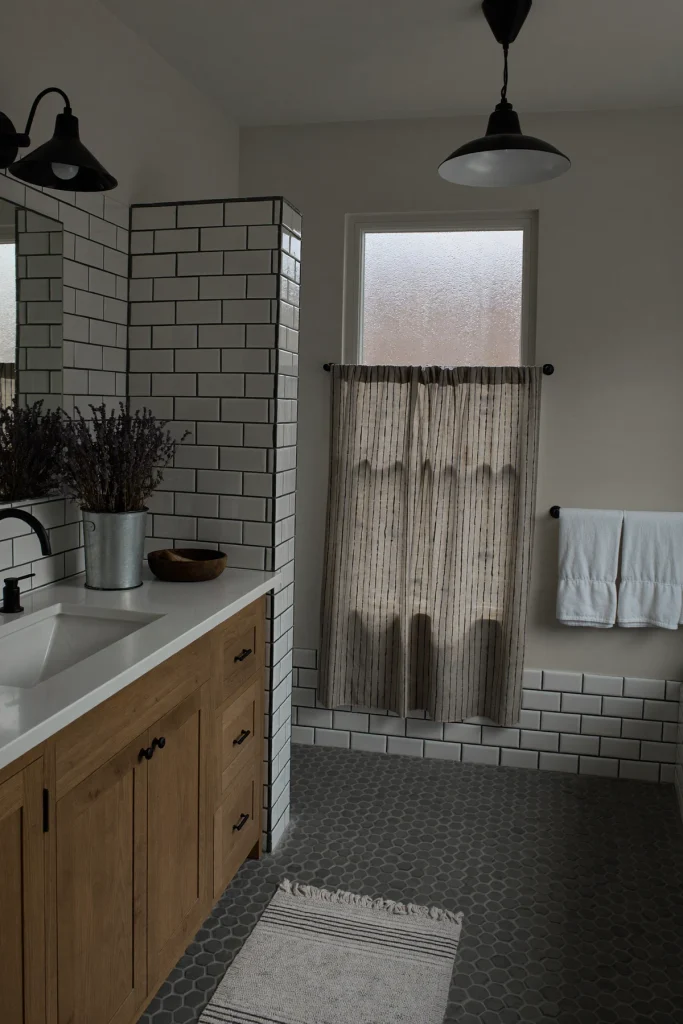
Grout might be the most overlooked design choice in a bathroom. And it changes everything.
White subway tile with white grout looks soft and seamless. The same tile with charcoal grout looks graphic, a little industrial, and very farmhouse. It also highlights the pattern, so if you’ve chosen herringbone or a stacked layout, a contrasting grout makes sure everybody notices.
Darker grout is more forgiving too. It won’t show the grime the way pure white does, which is why I love it on floors.
Just make sure the tile is laid neatly. Contrast grout shows every wobbly line, so this isn’t the moment for a rushed install.
Grout Color Cheat Sheet
| If You Want… | Try This Grout |
|---|---|
| Calm and seamless | Match the tile |
| Graphic and bold | Charcoal or black |
| Soft vintage | Warm grey |
| Subtle warmth | Sand or oat |
Inset a Mosaic Border Like a Rug
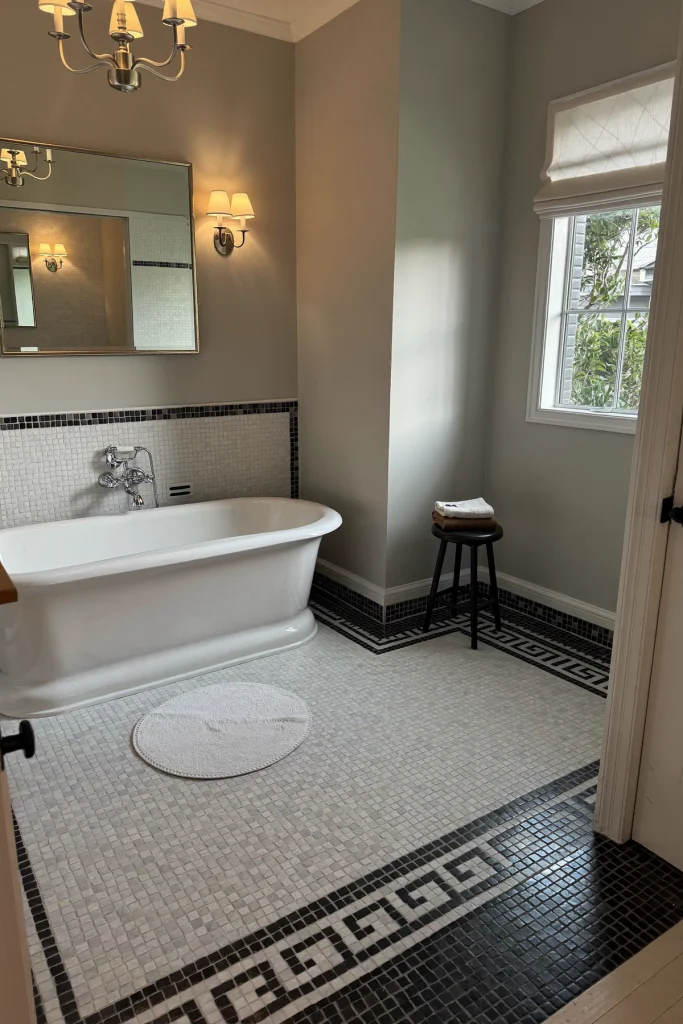
This is one of my favorite old-world tricks. Instead of one tile across the whole floor, frame a central field with a border, and the floor starts to look like it has a permanent rug laid on it.
Use a simple white or cream mosaic for the center and a darker band, maybe a Greek key, a simple stripe or a row of small squares, about a foot in from the walls.
It’s especially beautiful in a traditional suburban bathroom with a freestanding tub, because the border frames the tub like a picture. Remember the basketweave from idea 13? It makes a lovely center field inside a border like this.
Measure the room carefully before ordering. The border needs to sit an even distance from every wall, so off-square rooms need a little planning.
Make the Shower Niche a Feature With Accent Tile
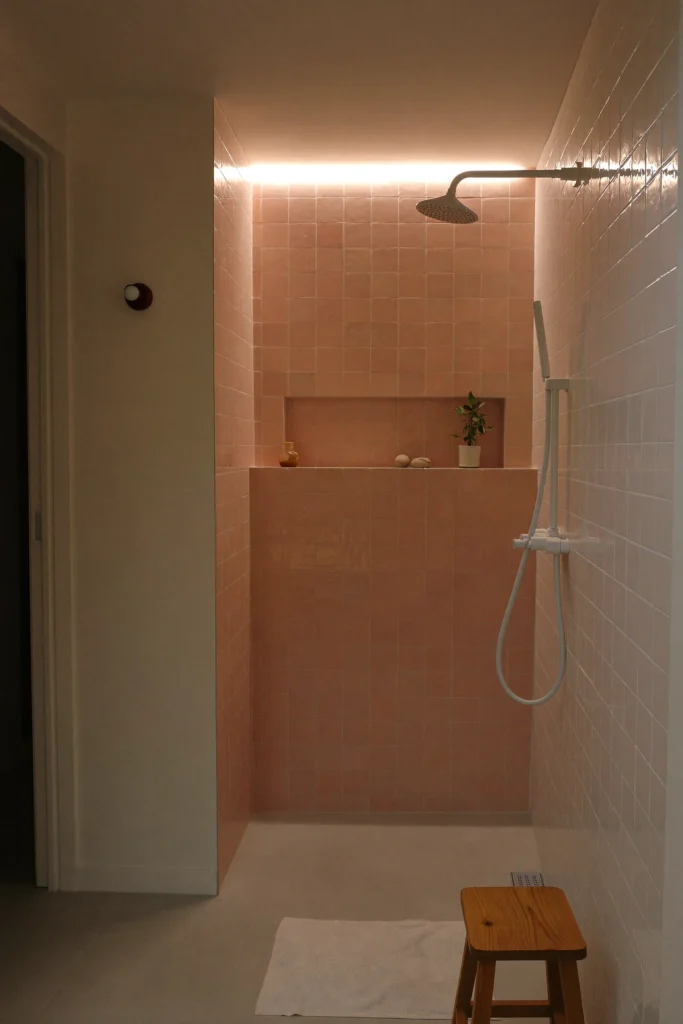
A shower niche is practical: somewhere to put the shampoo that isn’t the floor. But it’s also a perfect little canvas for an accent tile.
Line the back of the niche with something unexpected: a glossy blush zellige, a small marble mosaic, or a contrasting color of the same tile used elsewhere. In a calm Scandinavian bathroom with white walls, a soft terracotta-pink niche feels like a happy surprise. 💗
Add a small waterproof LED strip along the top edge and the niche glows softly at night, which doubles as a nightlight.
Keep what goes inside simple: a couple of plain bottles, a smooth stone or a tiny plant, not a whole drugstore aisle.
Step-by-Step
- Plan the niche size to match your tile so you avoid tiny slivers.
- Waterproof the niche fully before tiling.
- Slope the bottom shelf slightly so water drains out.
- Finish the edges with a slim metal trim or bullnose tile.
Lay a Bold Art Deco Fan Tile in the Powder Room
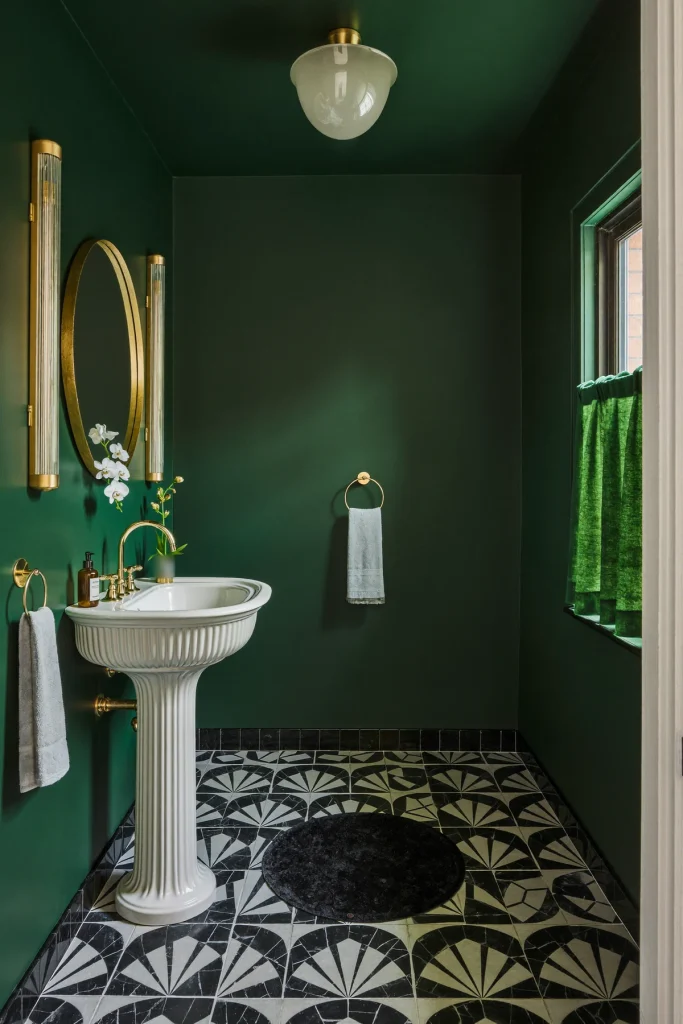
The powder room is where you can be brave. It’s small, guests see it, and nobody’s spending an hour in there, so a bold floor is pure fun.
Art Deco fan tile, with its repeating scallops and sunburst shapes, looks like it was pulled straight out of a 1920s apartment lobby. Do it in black and white for the full graphic effect, or try navy and cream if you want it a touch softer.
Match it with deep jewel-toned walls, a brass sconce or two, and a fluted pedestal sink. Suddenly that tiny half bath is the most memorable room in the house.
Small space also means less tile to buy, so you can spend a little more per square foot without blowing the budget. That’s the beauty of going bold in a small room. 💎
Mix Two Tiles With a Clean Color Break
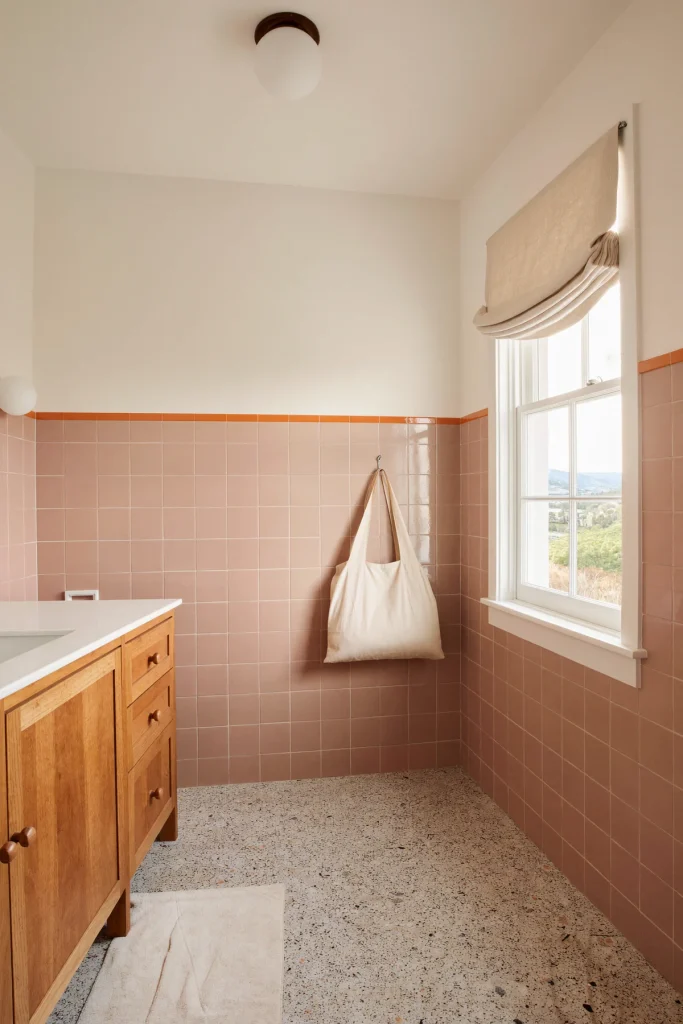
Mixing tiles is where many people get nervous. The secret is to change only one thing at a time: color, size or shape, not all three.
Try a soft blush square tile on the lower walls and a speckled terrazzo floor, meeting at a crisp line. Or run sage zellige up the shower and stop it right at the vanity, where plain plaster takes over.
A clean break works best when it lines up with something real: the top of the vanity, the edge of a window, the line of the shower glass. That way it looks planned rather than random.
Keep the grout color consistent between both tiles so they feel related. And keep fixtures simple: one metal finish, one wood tone.
Pair It With Idea #10
A terrazzo floor is the easiest partner for a solid-color wall tile, because its chips can pick up the wall color and tie the two together.
Choose a Classic Tile Shape in an Unexpected Color
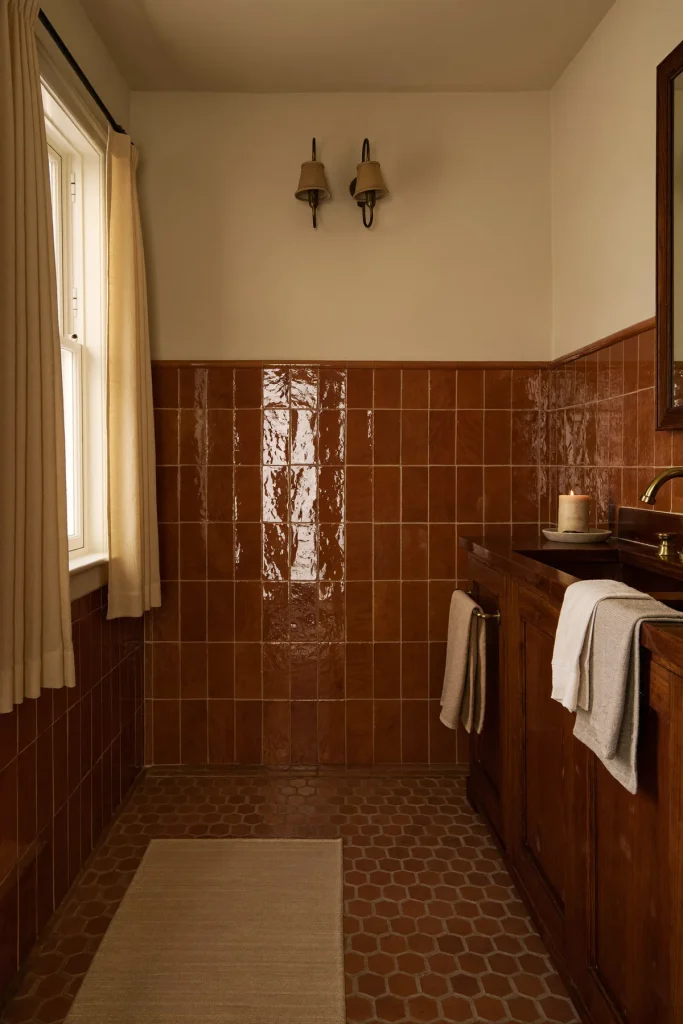
A simple rectangle, laid in a familiar brick or stacked pattern, is the most classic tile there is. So the way to make it special is color.
Skip white and try a glazed dusty rose, a burnt sienna, or a deep moss green. In a Craftsman bungalow, a rust-colored glossy tile with hand-glazed ripples feels warm and handmade, like pottery.
Because the shape is so familiar, the color gets all the attention. That makes it a safe way to try something bold: if you love the color, the layout won’t be the thing that dates it.
Pair it with cream walls, a warm wood vanity and aged brass. Keep the floor quieter, maybe a simple hexagon in oat or cream, so the walls can shine. 🍂
Choose Glass Tile for a Shower That Glows
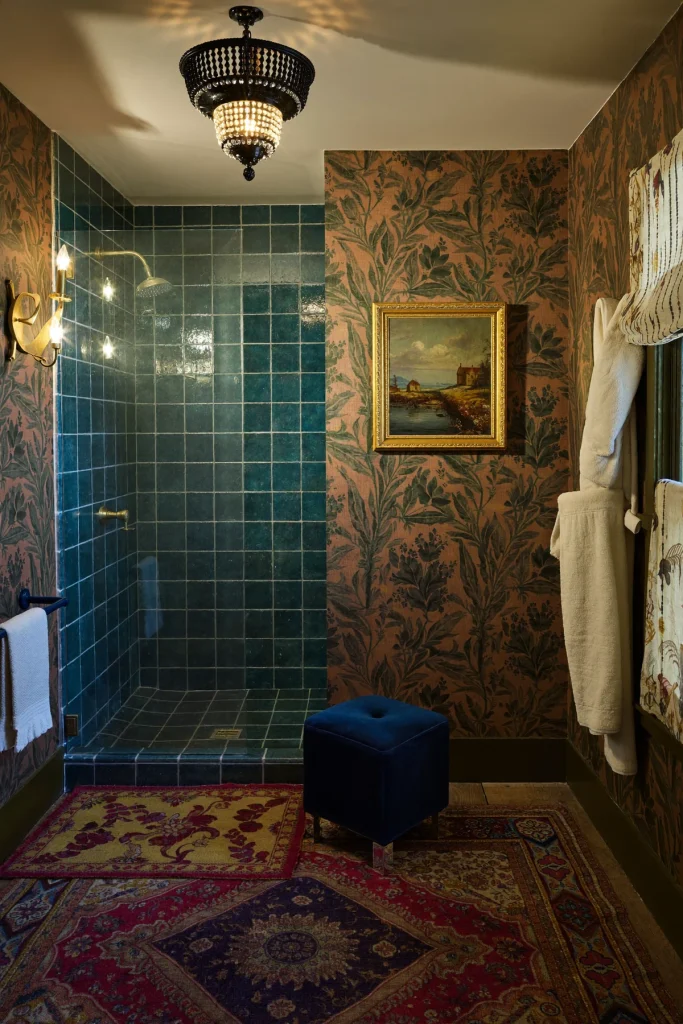
Glass tile has a depth that ceramic can’t match. Light passes into it and bounces back out, so a shower wall in glass feels luminous, almost like water.
A deep teal or peacock blue glass in a small rectangular format is pure drama. It suits a maximalist bathroom with patterned wallpaper outside the shower, a velvet stool and layered rugs.
Glass tile is easy to clean and doesn’t absorb water, so it’s practical too. It does need careful installation with white thinset so the backing doesn’t show through.
Use it in one zone, the shower or behind the vanity, rather than everywhere, so it stays special.
Do This 👉 / Not This ❌
- 👉 Use glass on walls. ❌ Don’t use smooth glass tile on a shower floor; it’s slippery.
- 👉 Choose a matching or slightly lighter grout. ❌ Don’t let dark grout overpower the shimmer.
Wrap the Room in Marble Mosaic for Hollywood Regency Glamour
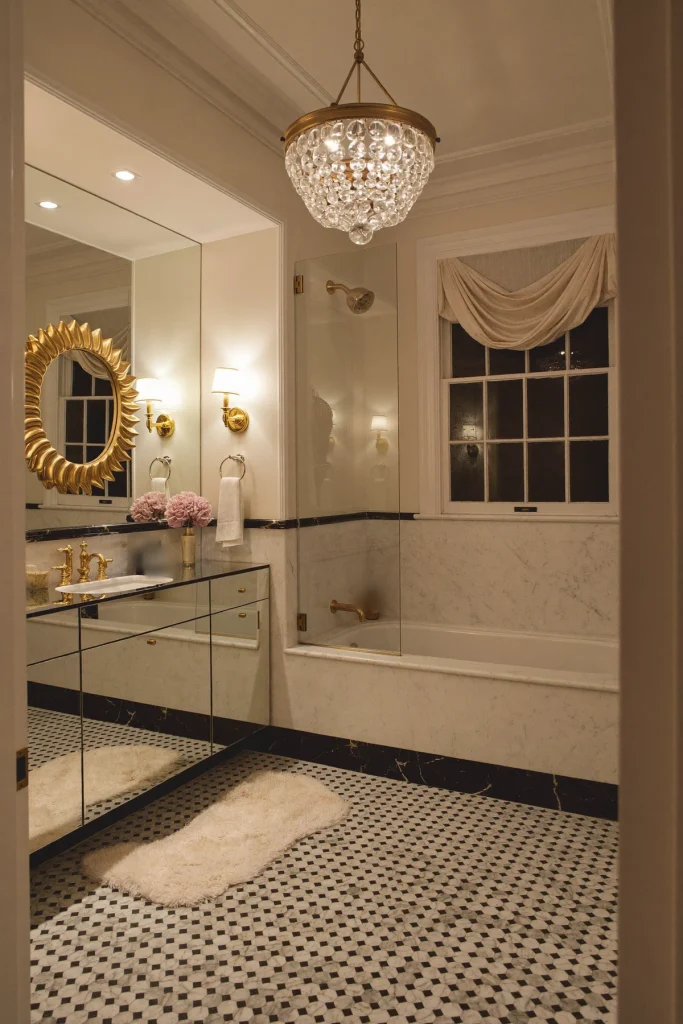
Sometimes you want a bathroom that feels like an old movie. That’s when you go all in on marble mosaic.
Picture black and white marble in a small geometric pattern across the floor, white marble on the walls, and a band of black marble trim at chair rail height. Add gold fixtures, a mirrored vanity and a dramatic chandelier. It’s glamorous, bold, a little over the top, and that’s exactly why it works.
The trick is to keep the color palette tight. Black, white and gold. Maybe one soft accent, like blush. Too many colors and it tips from glamour into chaos.
Mosaics come on sheets, so the install is manageable, but the cuts around fixtures take time. Budget a little extra labor for this one and give your installer the tile layout in advance.
Lay Large-Format Pale Tile to Stretch a Small Room
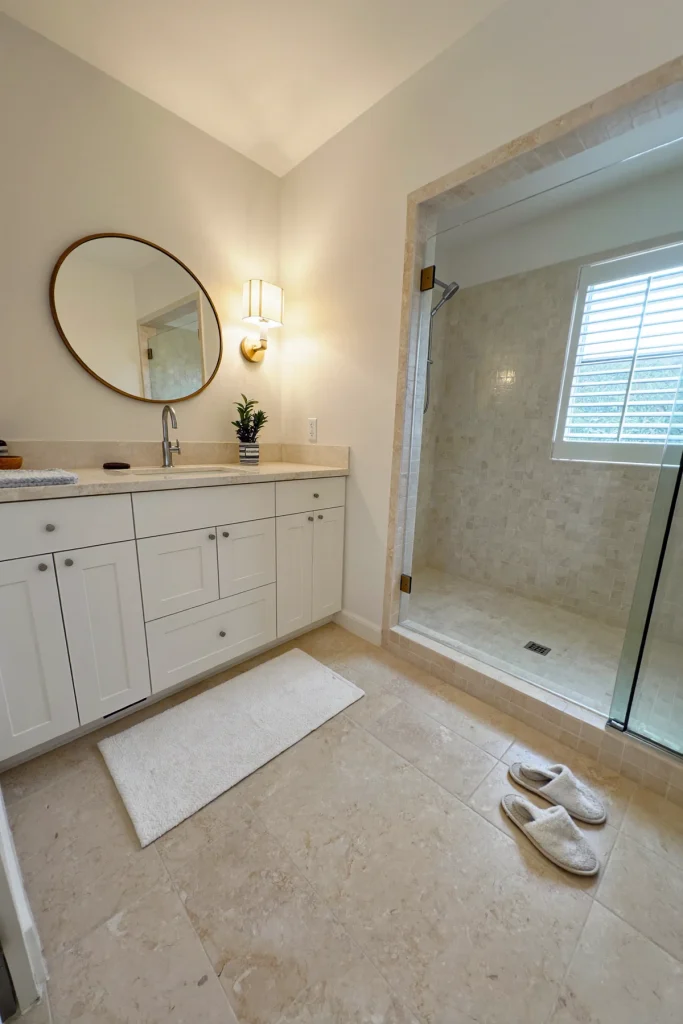
Small guest bathroom? Here’s a trick designers have used for decades: go big and go pale.
Large tiles, around 24 inches square, mean fewer grout lines, so the floor looks like one continuous surface. Lay them on a 45-degree angle if you can, and your eye follows the longest line across the room, which makes it feel even wider.
Choose a light, warm color like soft limestone or pale greige so the floor bounces light around. Keep the walls bright and the vanity leggy so you can see more floor.
Yes, a diagonal layout means more cuts and a little more waste. Plan on ordering about 15% extra. But in a tiny room, that extra tile won’t cost much, and the space will feel so much bigger.
Small Space Hack
Run the same floor tile into the shower (with a linear drain) and skip the curb. One continuous floor makes a small bathroom feel twice the size.
Build a Tiled Bench Into the Shower
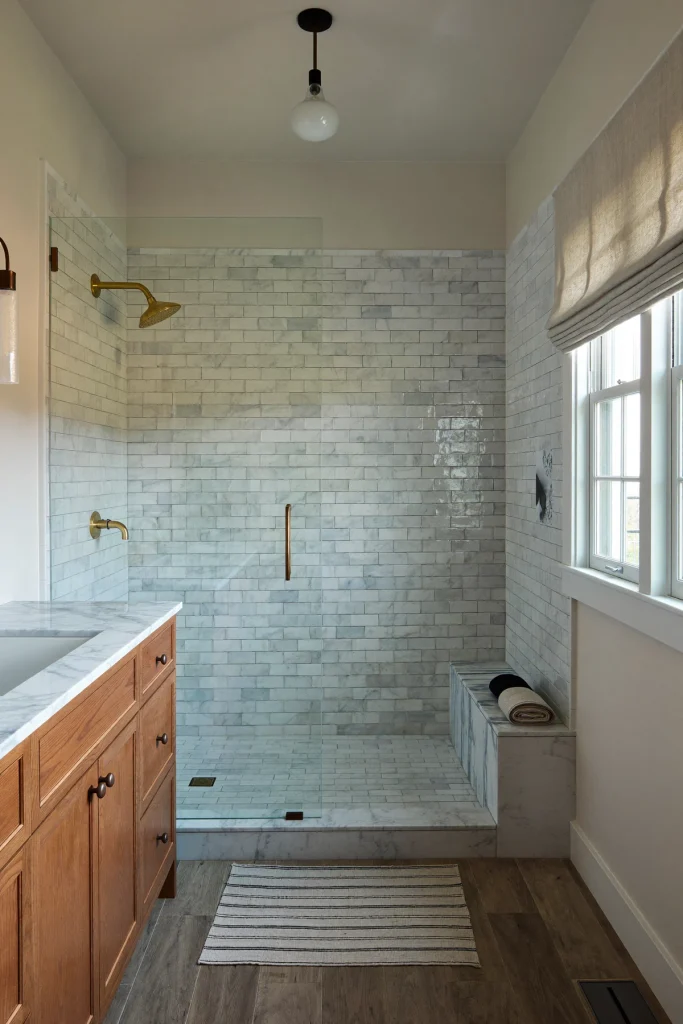
A built-in shower bench sounds like a luxury, but it’s one of the most practical things you can add. Somewhere to shave your legs, rest a foot, or let a little one sit during bath time.
Tile it in the same tile as the shower walls for a seamless look, or cap it with a single piece of stone or a contrasting tile for a little definition. In a modern farmhouse bathroom, a white zellige shower with a honed marble bench top feels fresh and grounded.
Floating benches look sleek, while solid built-in boxes feel more traditional and give you more seating.
Either way, plan it before the walls are framed. Benches need proper support and waterproofing, and they need to slope slightly toward the drain so water never sits on top.
Stack Ribbed Tile Behind the Freestanding Tub
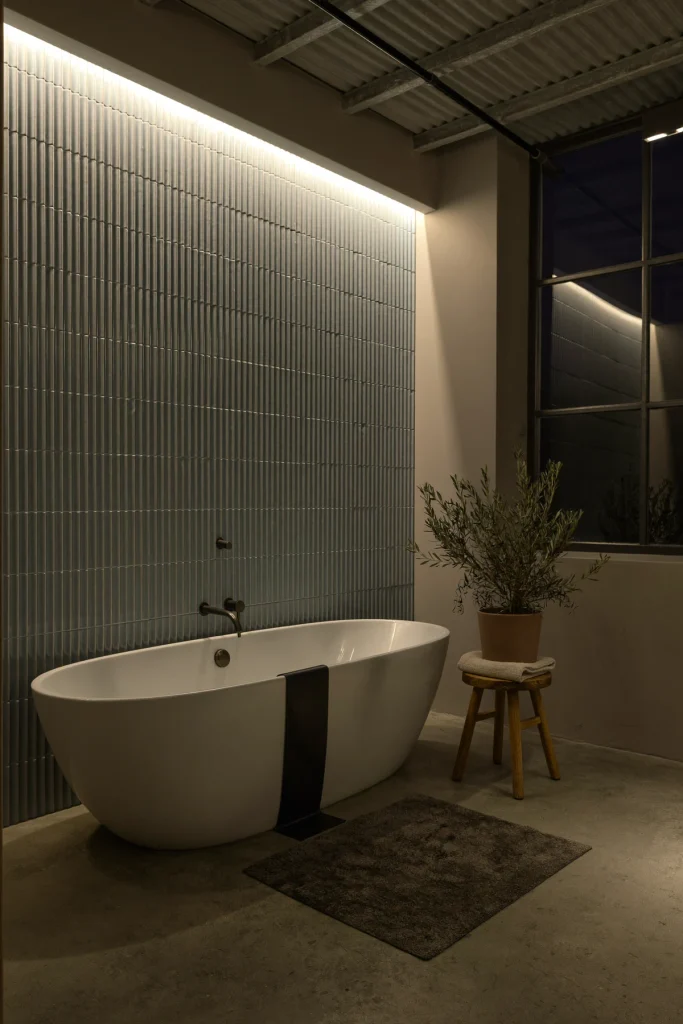
Ribbed or fluted tile has lines of raised texture that catch light and shadow. Behind a freestanding tub, it becomes a sculpture.
Try a warm grey or soft concrete color for a modern brutalist bathroom with poured concrete floors and a matte black tub filler. The ribs add softness to all that solid material.
Light it from above with a wall washer or a hidden LED strip and it changes all evening, from soft and subtle to dramatic at night.
Ribbed tile is a little harder to clean than smooth tile, so it’s better on a wall that doesn’t get direct shower spray. Behind the tub is perfect.
Keep the rest of the room calm and minimal, maybe just a wooden stool and a single plant. The texture is the decoration. Remember the tiled ceiling from idea 11? These two ideas together make a bathroom that feels like a quiet, carved stone retreat. 🪨
Let Your Tile Choose the Towels and Textiles
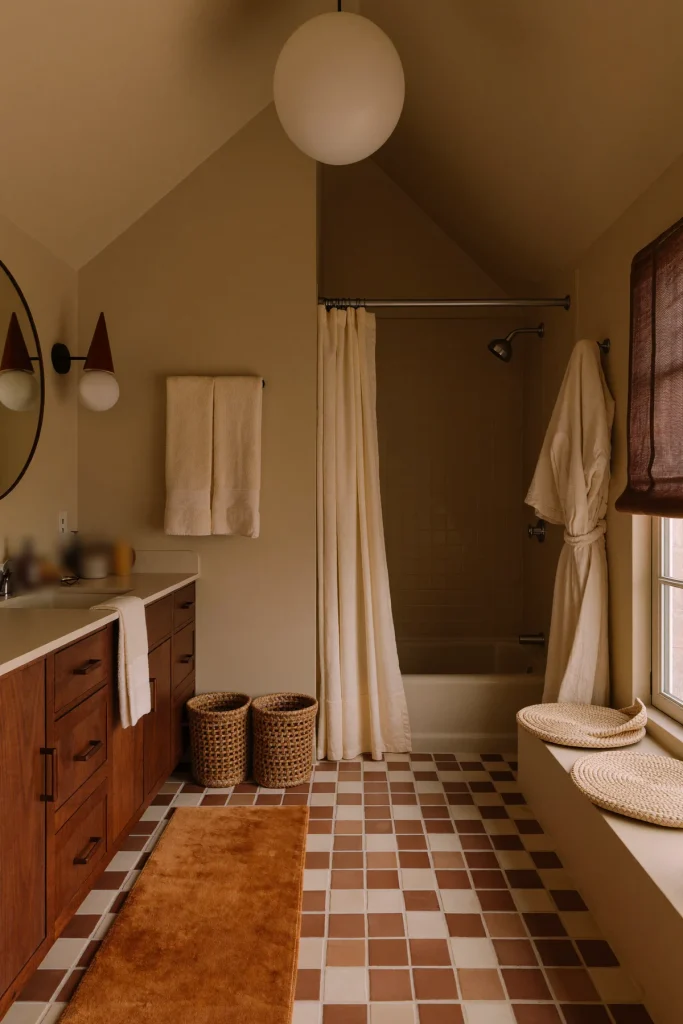
Once your tile is in, it should guide every soft thing you bring into the room. Towels, bath mats, shower curtains, even the robe on the hook.
Pull one color from the tile and repeat it. If you’ve got a patterned cement floor, pick the quietest color in the pattern for your towels. If your tile is plain white, bring in texture instead: waffle-weave towels, a linen shower curtain, a striped cotton bath mat.
Patterned tile likes plain textiles. Plain tile can handle a little pattern. That’s the whole rule.
It’s also the cheapest way to change the feel of your bathroom with the seasons. Crisp white and sage in spring, warm rust and oat in fall. The tile stays, the mood shifts. Look back at idea 4: a cement floor like that one is happiest with solid cream or moss towels and nothing fussy. 🌼
Finish Tile Edges With Slim Metal Trim
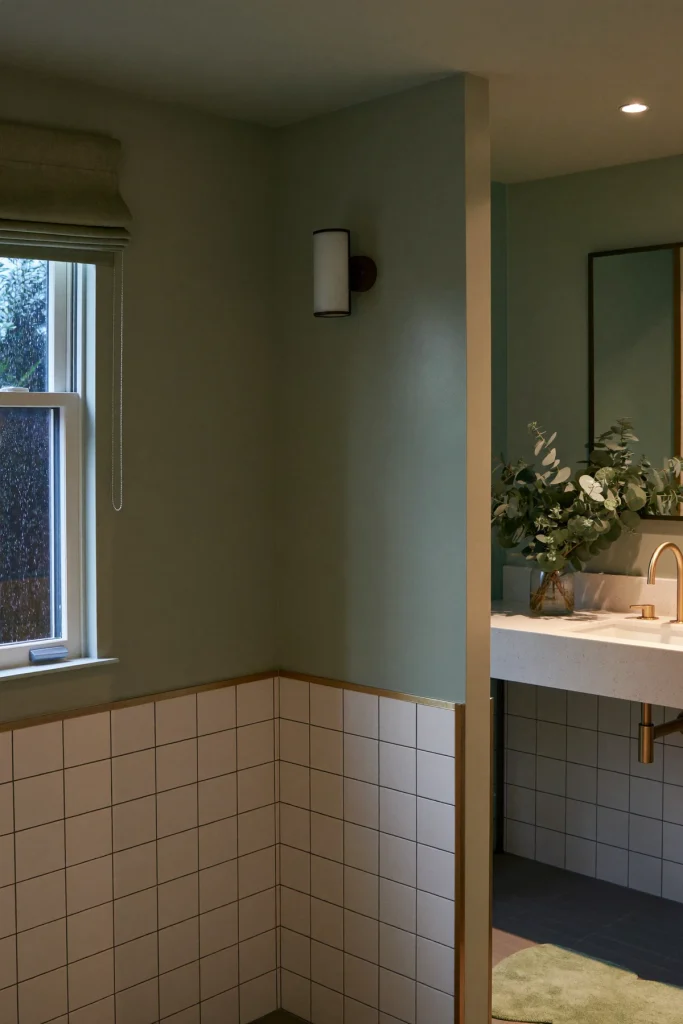
Where tile stops matters as much as the tile itself. A raw, cut edge looks unfinished. A clean metal trim makes everything look crisp and professional.
Slim metal edge profiles come in brushed brass, matte black, brushed nickel and white. Match them to your faucet finish for a pulled-together look. They’re perfect on outside corners, around niches, along window ledges, and where tile meets a painted wall.
If you want something softer, bullnose tile or pencil trim does a similar job with a more traditional feel, the way it did at wainscot height in idea 7.
This is one of those details nobody notices when it’s done right, but everyone senses when it’s missing. It’s the difference between a bathroom that looks DIY and one that looks designed. Ask about it early, because trims need to go in as the tile is set, not afterward.
Checklist
- Choose your trim finish to match your fixtures.
- Count every outside corner and niche edge.
- Order trim pieces with your tile, not after.
- Confirm the trim depth matches your tile thickness.
Find the Tile That Feels Like You
The best bathroom tile isn’t the trendiest one. It’s the one you’ll still love on a sleepy Tuesday morning five years from now. Start with how you want the room to feel, calm, cozy, bold or bright, and let that guide the pattern, the material and the grout.
Order samples. Tape them up. Look at them in the morning and at night. Squint from the doorway. You’ll know the one when you see it.
And remember: tile does the decorating for you. Pick well, keep everything else simple, and your bathroom will feel finished from the day the grout dries. 💛
